Key takeaways
- Every cover letter needs at least two sentences that could only apply to that specific company and role.
- Add one short line stating your right to work, like "I hold full working rights in Australia" - don't make a recruiter guess.
- Describe what you did, not just your old job title - a literal translation can confuse an Australian recruiter about what the role involved.
We read a lot of cover letters at DreamShift. Hundreds of them. And when a strong candidate gets rejected, it's rarely because they weren't good enough for the job. It's because their cover letter made them look like the wrong fit before the recruiter even got to the CV.
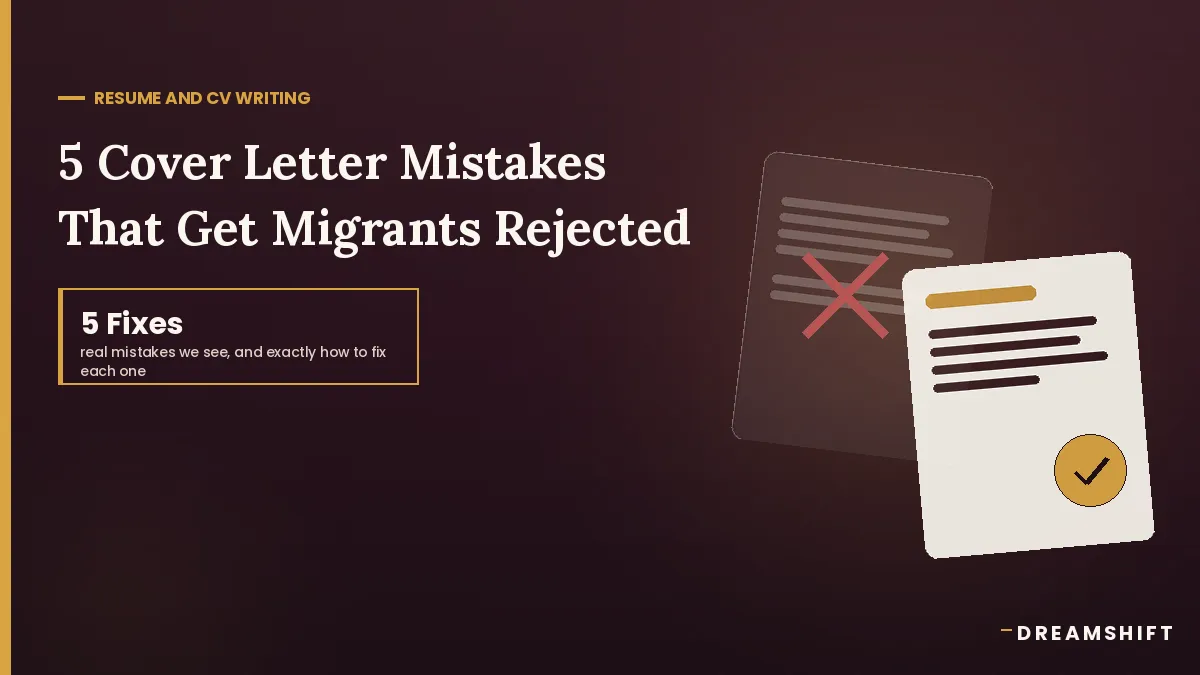
Here are the five mistakes we see most often from migrant candidates, and exactly how to fix each one.
Mistake 1: Opening with your life story instead of the job
A lot of candidates open with something like: "I moved to Australia in 2023 with a dream to build a career in my field, and I have always been passionate about..."
Recruiters don't have time for this. They're scanning for one thing in the first two lines: can this person do the job I'm hiring for?
The fix: Open with the role and your strongest matching qualification. Something like: "I'm applying for the Business Analyst role at [Company]. I've spent four years translating stakeholder requirements into technical specs for logistics and retail clients." That's it. Save your story for the interview, where someone will actually ask for it.
Mistake 2: Writing one generic letter for every job
This is the biggest one. We can always tell when a cover letter has been sent to fifty companies, because it never mentions the company name, the actual role, or anything specific about what the job needs.
The fix: Every cover letter needs at least two sentences that could only apply to this job. Mention the company by name. Reference something from the job ad directly, like a required skill or a project type, and say how your experience matches it. This takes five extra minutes per application and it's the single biggest thing that separates a letter that gets read from one that gets skipped.
Mistake 3: Not explaining your right to work
This one is specific to migrants, and it trips up a lot of strong candidates. If a recruiter can't quickly tell whether you're legally allowed to work in the role, they'll often move on to the next application rather than chase it up.
The fix: Add one short, confident line near the end: "I hold full working rights in Australia" or "I am on a [visa type] with no restrictions on hours." If there's a visa condition relevant to the role (like hour limits for a student visa), state it plainly rather than leaving it to guesswork. This isn't oversharing. It answers the recruiter's first silent question before they have to ask it.
Mistake 4: Translating your old job title literally
If your previous job title doesn't mean anything to an Australian employer, a literal translation can actually work against you. We've seen candidates list titles that sound senior in their home country but confuse an Australian recruiter about what the role actually involved.
The fix: Describe what you did, not just what you were called. Instead of listing an unfamiliar title alone, add a short clarifying phrase: "Senior Officer (equivalent to Team Lead, managing a team of 6)." Recruiters aren't trying to catch you out here, they genuinely don't know the job market you came from, so give them the translation.
Mistake 5: Being too formal, or using the wrong formal
Some candidates write in a style that's extremely formal, with long sentences, old-fashioned phrases like "I am writing to humbly submit my application," or no personality at all. Others go the opposite way and sound like a casual email to a friend. Both miss the mark.
The fix: Aim for professional but plain. Write like a capable person talking to another capable person, not like you're submitting a legal document. Short sentences. Clear points. One or two lines that show you actually have a personality, because the recruiter is going to work with you, not just read your application.
The pattern behind all five mistakes
Look at these five mistakes together and you'll notice something: every one of them comes from writing the letter for yourself instead of for the recruiter reading it. A recruiter wants three things, fast: can you do the job, can you legally work here, and will you be easy to work with. A good cover letter answers all three in under 200 words.
If you want a second pair of eyes on your cover letter before you send your next application, that's exactly the kind of thing we check for at DreamShift. A few small fixes can be the difference between getting skipped and getting a call back.