If you’re navigating a partner visa Australia application alongside your own migration journey, or your partner is your pathway to staying here, the timelines and rules have shifted enough recently that old advice can be misleading. Here’s where partner visa Australia processing actually stands in 2026.
How long it actually takes
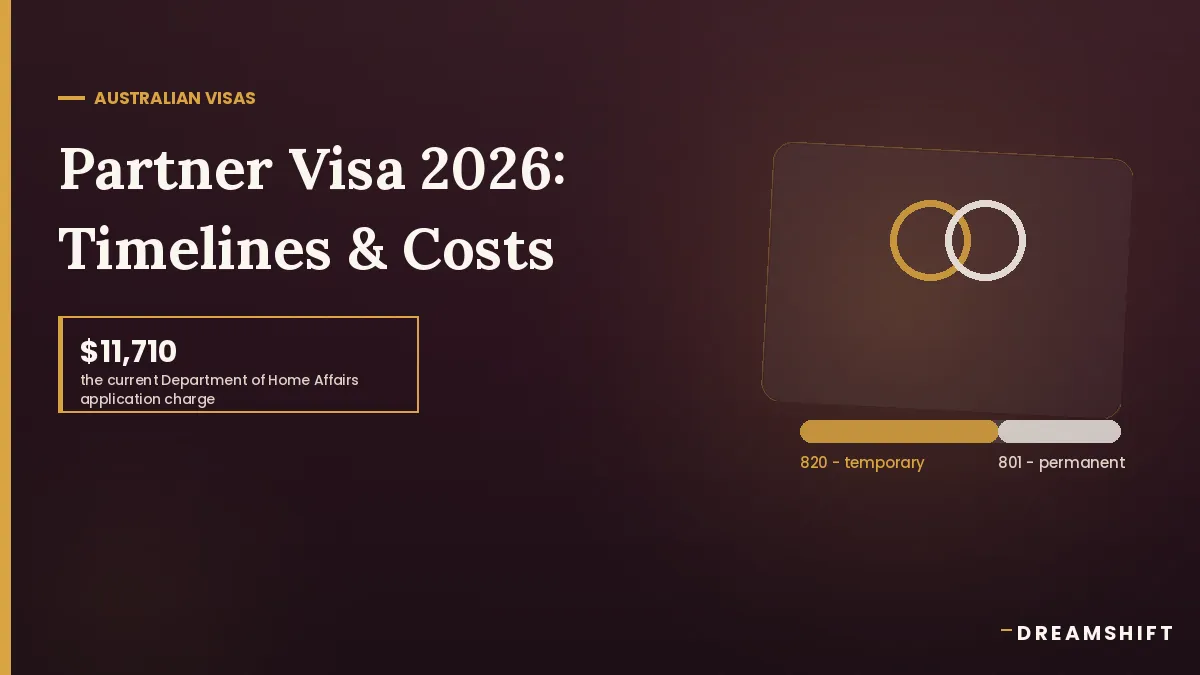
Partner visas run in two stages – a temporary visa first, then a permanent one – and the Department of Home Affairs publishes processing times for each. For the onshore pathway:
- Subclass 820 (temporary, onshore): 50% of applications are processed within 18 months, 90% within 32 months
- Subclass 801 (permanent, onshore): 50% within 8 months, 90% within 17 months
For the offshore pathway, it’s broadly similar:
- Subclass 309 (temporary, offshore): roughly 12-24 months from lodgement
- Subclass 100 (permanent, offshore): around 10-19 months
Add the two stages together and most applicants should realistically plan for 12 to 24 months before the temporary visa comes through, and longer again before permanent residency is finalised. The advice from migration lawyers is consistent: plan around the longer end of these ranges, not the median – a lot of cases land closer to the 90% mark than the 50% one.
What it costs
The Department of Home Affairs application charge for the primary applicant is $11,710 (current from 1 July 2026), covering both stages of either the onshore or offshore pathway. On top of that, budget for:
- Health examinations: roughly $400-700 per adult
- Police clearance certificates (cost depends on your country)
- Document translation, if any of your evidence isn’t in English
- Migration agent fees, if you choose to use one
The government fee alone puts this among the more expensive visa pathways in the system, which is exactly why getting the application right the first time matters – a request for more information, or a refusal, extends an already long timeline.
What changed in 2024, and why it still matters in 2026
The most significant recent shift took effect on 1 July 2024, and its effects are still shaping how partner visas are decided:
Subclasses 309 and 820 were more closely aligned. The two visas now carry more consistent rights, reducing some of the gaps that previously existed between the offshore and onshore pathways.
Family and domestic violence protections were strengthened. Applicants on the offshore Subclass 309 no longer need to be onshore at the “time of decision” if their relationship broke down due to family violence, provided they were in Australia when they originally applied. Both 309 and 820 holders also gained fuller access to relationship-cessation provisions where family violence is involved, with a lowered threshold for accessing those protections.
Evidence requirements eased in one specific case. If your sponsoring partner has died, you’re no longer required to demonstrate ongoing ties to Australia to continue your application.
If you’re relying on any of these provisions, it’s worth confirming the current detail with a registered migration agent or directly with the Department, since family violence and bereavement provisions involve sensitive evidentiary requirements that are easy to get wrong without guidance.
What partner visa Australia applicants need to know now
- Budget time, not just money. A processing time of 18-32 months for the first stage alone means a partner visa is rarely a short-term bridge – treat it as a multi-year process from the start.
- Get your evidence right the first time. Given how long each stage takes, a request for additional information can add months you don’t get back. Relationship evidence (joint finances, shared residence, social recognition of the relationship) is worth over-preparing rather than under-preparing.
- Know that 309 and 820 now sit closer together. If you’re weighing whether to apply onshore or offshore, the rights gap between the two options has narrowed since 2024 – it’s less of a binary trade-off than it used to be.
- If family violence is part of your situation, you have more protection than you might assume. The 2024 changes were specifically designed to stop victim-survivors from being trapped in a relationship purely to protect a visa application – don’t assume you have to stay onshore, or stay in the relationship, to keep your case alive.
FAQ
How long does a partner visa take in Australia in 2026?
For the onshore pathway, expect 18 months (50% of cases) to 32 months (90% of cases) for the temporary Subclass 820, followed by 8 to 17 months for the permanent Subclass 801. Offshore processing (309/100) runs on a similar overall timeline.
How much does a partner visa cost in Australia?
The Department of Home Affairs application charge for the primary applicant is $11,710, plus health checks, police clearances, and any translation or migration agent costs.
What happens to my partner visa application if the relationship ends due to family violence?
Since July 2024, both onshore (820) and offshore (309) applicants have fuller access to family violence cessation provisions, with a lowered threshold for evidence, and 309 applicants no longer need to be onshore at the time of decision if violence caused the relationship breakdown.
Is it better to apply for an onshore or offshore partner visa?
The two pathways were more closely aligned from July 2024, narrowing the rights gap between them. The right choice still depends on your individual circumstances, including where you and your partner are currently based.