Key takeaways
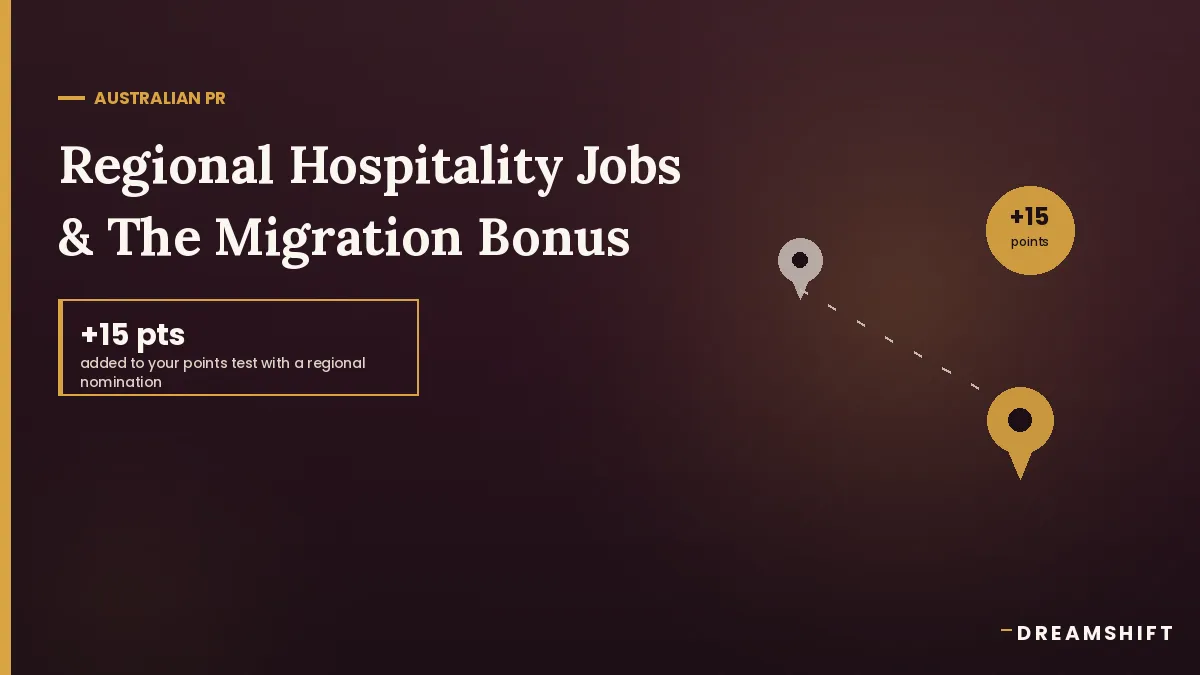
- A regional nomination adds 15 points to your skilled migration score, and the 491 visa leads to permanent residency after three years.
- Regional means anywhere outside Sydney, Melbourne and Brisbane, including Perth, Adelaide, the Gold Coast and all of Tasmania.
- Café and restaurant manager roles appear on several regional occupation lists, so your current career path may already qualify.
Here's a question we get a lot from clients working in cafes, restaurants, and hotels: "Should I move to a regional area for work, or stay in the city?"
It's a fair question. Moving regional feels like a big step, especially if your social life, your community, or your partner's job is all set up in Sydney or Melbourne. But if you're serious about permanent residency, regional hospitality roles can genuinely speed things up. Here's how to actually weigh it.
What counts as "regional" in Australia
Regional isn't just small country towns. For skilled migration purposes, "regional Australia" is anywhere outside the Sydney, Melbourne, and Brisbane metro areas. That includes Perth, Adelaide, the Gold Coast, Newcastle, Canberra, all of Tasmania, the Northern Territory, and regional parts of every state.
So "going regional" might mean Adelaide or the Gold Coast, not necessarily a town of 3,000 people. That changes the calculation for a lot of people.
The visa upside: the 491 and the points bonus
The main regional pathway is the Skilled Work Regional (Provisional) visa, subclass 491. Here's what matters for hospitality workers specifically:
It carries real points. A state or territory regional nomination adds 15 points to your skilled migration points test score. That's a significant jump when competitive scores usually sit between 70 and 85.
It leads to permanent residency. The 491 runs for five years. After three years of meeting the conditions (living and working in a designated regional area, meeting an income threshold, no serious visa breaches), you become eligible for the subclass 191 visa, which is permanent.
Hospitality and management roles can qualify. Café and restaurant manager roles, along with other hospitality or venue management occupations, appear on various state and territory regional occupation lists. This changes by state and by year, so you need to check the current list for wherever you're considering, but it's a real pathway, not a long shot.
The requirements are specific. You'll need a positive skills assessment for your occupation (budget three to six months and a few hundred to a couple thousand dollars for this), competent English (IELTS 6.0 in each band, sometimes higher depending on the occupation), and to be under 45.
The practical upside beyond the visa
Points aside, regional hospitality has some real advantages that don't show up in the visa paperwork:
Less competition for promotion. Fewer experienced hospitality managers want to relocate regionally, which means faster progression into supervisor and management roles than you'd typically see in an oversaturated city market.
Lower cost of living. Rent and everyday costs are usually meaningfully lower outside the big three cities, which matters a lot when you're also saving for visa and migration costs.
Genuine shortage, genuine demand. Regional hospitality venues are often short-staffed, especially in tourist areas and growing regional centres. That's leverage for you when negotiating pay, hours, or sponsorship conversations.
The real trade-offs
This isn't a one-sided pitch. Be honest with yourself about these costs:
The three-year commitment is real. The 191 pathway requires you to actually live and work regionally for three of the five years, not just hold the visa. If you're not prepared to build a life there, this isn't the right pathway.
Job density is lower. Fewer venues means fewer options if something goes wrong with your current role. In a city, you can often walk into another hospitality job quickly. Regionally, that safety net is thinner.
Social and family adjustment. If your partner, kids, or close community are in the city, this is a genuine lifestyle change, not just a work decision.
How to decide
Ask yourself three questions before committing:
Is the occupation on the current regional list for the state you're considering? Check this directly, since lists change and this is the single biggest factor.
Can you realistically commit to three years in that location? Not "I'll try it," but genuinely plan your life there for three years.
Does the math work? Add up the points bonus, the faster promotion path, and the lower cost of living against what you'd be giving up in the city.
If the answers line up, a regional hospitality move can take years off your path to permanent residency while also fast-tracking your career. If they don't, it's completely fine to stay metro and build your case a different way.
If you want help checking whether your current role (or the one you're aiming for) actually qualifies for a regional pathway, and what your points would look like, get in touch with DreamShift. We'll walk through the real numbers with you before you make the move.