Key takeaways
- An AI-detection flag isn't a verdict, but repetitive stock phrases, buzzwords without evidence, and American spelling all make a recruiter suspicious fast.
- The gap between a polished AI-written letter and a less confident spoken interview is what actually costs the job offer, not the AI use itself.
- Use AI to get unstuck or tighten grammar, then rewrite it in your own words, add one detail only you would know, and switch the spelling to Australian English.
Almost every client who comes to us now has already asked ChatGPT to write their cover letter. That's not a bad instinct. The question isn't whether to use AI at all, it's where it helps and where it quietly costs you the interview.
Here's what recruiters actually notice, and how to use AI without it working against you.
Recruiters aren't guessing. They're pattern-matching.
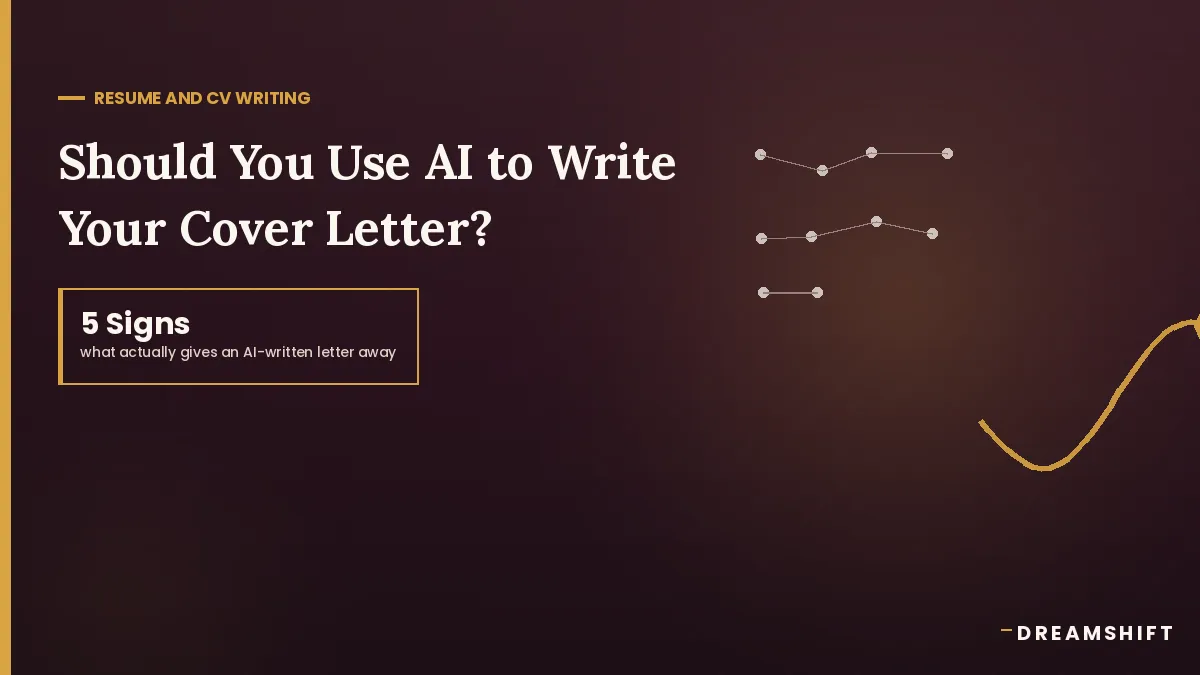
Some recruiters use AI detection tools as a first screening step. These tools aren't perfect, and most recruiters know that, so they treat the result as one signal, not a verdict. But even without a detector, an experienced recruiter reading hundreds of applications a week starts to recognise AI writing on sight. Here's what gives it away.
The five giveaways
Repetitive phrasing and stock transitions. AI-written text leans on the same connector words over and over: "Furthermore," "Moreover," "In today's competitive job market." One of these in a cover letter is fine. Three or four, and it reads like a template.
Buzzwords without evidence. AI tools love words like "dynamic," "cutting-edge," and "passionate," attached to ordinary tasks. "I bring a dynamic approach to cutting-edge data entry" is a sentence that tells a recruiter nothing real about what you did.
American spelling. Most AI tools default to American English. If your cover letter says "analyzed," "organized," or "specialized" instead of the Australian spelling, that's often the clearest tell that you pasted in AI output without checking it.
A tone that doesn't match your English at interview. This is the one that actually costs people the job. If your cover letter reads at a polished, idiomatic native-speaker level, and then you speak with a noticeably different style or confidence level at interview, the recruiter notices the gap immediately. It doesn't just look like you used AI, it looks like you weren't honest about your own writing level.
Generic structure that could apply to any job. AI tools, when given a bare job title and a CV, tend to write something broadly accurate but specific to nothing. No real recruiter, no real project, no real reason you're applying to this company. The letter could be sent to fifty different jobs without changing a word.
So should you use it or not?
Use it, but as a drafting tool, not a final-answer tool. Here's where AI genuinely helps:
Getting unstuck on a blank page. If you don't know how to start, asking AI for a rough first draft based on your CV and the job ad is a completely reasonable way to get moving.
Checking grammar and structure. AI is good at catching awkward phrasing and tightening sentences, especially if English isn't your first language.
Brainstorming what to include. AI can help you think through which parts of your experience are most relevant to a specific job ad.
Where you need to take over
Rewrite it in your own words. Take the AI draft and change the sentences so they sound like you talking, not like a template. Read it out loud. If it doesn't sound like something you'd actually say, change it.
Add one detail only you would know. A specific project, a specific number, a specific reason you want this company. AI can't invent this convincingly, and it's exactly what makes a letter feel real.
Switch the spelling to Australian English. A five-second fix that removes one of the biggest giveaways. Change your AI tool's settings to Australian English if it has the option, or run a quick find-and-replace before you send anything.
Match your letter to your actual spoken English. If you're not yet confident writing in highly polished English, don't submit a letter that is. A slightly simpler letter that matches how you'll sound at interview is more trustworthy than a perfect one that doesn't.
The real risk isn't getting caught. It's getting the interview and then losing it.
Most recruiters won't reject you outright for using AI. The real cost shows up later: you get the interview on the strength of a polished letter, and then the gap between your written application and your spoken answers makes the interviewer doubt everything else in your application too.
Use AI to get started. Finish it yourself. That's the difference between a tool that helps you and one that quietly works against you.
If you want a cover letter that sounds like you, reads naturally, and still hits everything a recruiter is scanning for, that's exactly what we help with at DreamShift.