If you’re an electrician, plumber, or other tradie planning to move to Australia, a reform announced in the 2026-27 federal budget could cut months off the time it takes you to actually start working. Here’s what’s changing and why it matters.
This trade skills assessment Australia 2026 reform is one of the most practical pieces of good news for overseas tradies this year, and it pairs well with the broader hiring picture – engineering, mining and construction are among the fastest-growing sectors in the country right now, so faster licensing means faster access to that demand. See our breakdown of where the jobs are growing in 2026 for the full picture.
What’s actually changing
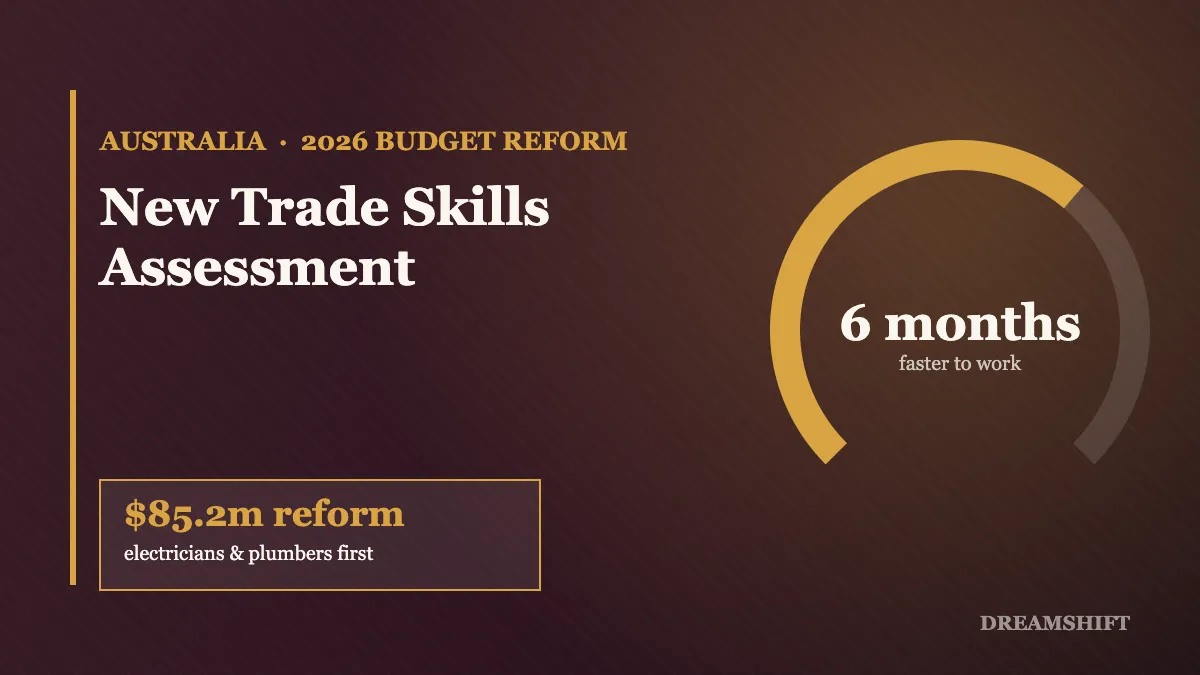
The government is putting $85.2 million over four years into modernising how overseas trades workers get assessed and licensed in Australia. The centrepiece is $75.1 million to rebuild the Trades Recognition Australia (TRA) skills assessment system, with the goal of building occupational licensing directly into the skills assessment process itself, instead of treating them as two separate, sequential steps.
Right now, a tradie moving to Australia typically has to complete a skills assessment first, then separately apply for a state or territory licence to actually work in their trade. That’s two processes, often with overlapping paperwork and separate wait times. The reform aims to streamline assessment-to-licensing pathways in partnership with the states and territories, so a tradie isn’t stuck waiting twice for essentially the same recognition.
Electricians and plumbers are the two trades being used as the initial focus for this streamlined approach, which makes sense given how in-demand both are.
How much time this could actually save
The government’s own estimate is that the reform could cut the time it takes an overseas tradie to start working in Australia by up to six months. That is a significant chunk of the wait that currently sits between “I’ve arrived” and “I’m earning.”
The stated goal is to add roughly 4,000 more trades workers into the Australian workforce each year as a result of the faster pathway. Separately, $5.6 million has been set aside specifically for people who are already in Australia on a visa, to help them get their existing overseas qualifications and experience formally recognised without leaving the country. Another $4.5 million goes toward stronger oversight of the assessing authorities themselves, with annual performance reporting starting in 2027 – a sign the government wants this reform to actually be measurable, not just announced.
Why electricians in particular should pay attention
The electrical trade has an extra reason to watch this reform closely. TAFE Directors Australia has said the country needs roughly 26,000 more electricians to meet its net zero and clean energy targets. That is a huge gap, and it lines up with Jobs and Skills Australia’s own Clean Energy Capacity Study, which has flagged electrical trades as a critical bottleneck for the energy transition.
If you’re an overseas-trained electrician, this combination – a national shortage this large, plus a government reform specifically designed to get you licensed faster – is about as favourable a set of circumstances as this trade is likely to see for a while.
What to do if you’re planning this move
Because this is a reform still being rolled out, the practical steps are:
- Keep an eye on the official Trades Recognition Australia and Department of Employment and Workplace Relations (DEWR) websites for the rollout timeline and exact process changes, since the details of how assessment and licensing will be combined are still being finalised with the states and territories
- If you’re an electrician or plumber, you’re in the first group this reform is designed around, so it’s worth starting your documentation and qualification-recognition preparation now rather than waiting for the full rollout
- If you’re already in Australia on a visa, look into the $5.6 million onshore skills assessment funding, which is specifically there to help people in your position
FAQ
How much faster will the new trade skills assessment be?
The government estimates the reform could reduce the time for overseas trades workers to start working in Australia by up to six months.
Which trades are being prioritised first?
Electricians and plumbers are the initial focus trades for the streamlined assessment-to-licensing pathway.
How much funding is behind this reform?
$85.2 million over four years in total, including $75.1 million to modernise the Trades Recognition Australia system, $5.6 million for onshore visa holders, and $4.5 million for stronger oversight of assessing authorities.
Is this reform already in effect?
It was announced in the 2026-27 federal budget and is being rolled out in partnership with state and territory governments – check the official Trades Recognition Australia and DEWR websites for the current status before making plans around it.
Sources
- Trades Recognition Australia – official site
- Department of Employment and Workplace Relations – Trades Recognition Australia
- Visa Envoy – Federal Budget 2026-27 migration and visa changes
- TAFE Directors Australia – 26,000 more electricians needed for a net zero economy
- Jobs and Skills Australia – Clean Energy Capacity Study
Note: this reform was still rolling out at the time of writing. Check the official Trades Recognition Australia or DEWR websites for the latest process details before relying on the timeline above.